You put the truck up on the drive, pull the rear wheel to look at the brakes, and there’s nothing to look at. No caliper. No shiny rotor. Just a smooth cast-iron bowl with a hub sticking out of the middle.
That’s a drum brake, and if you drive a pickup around Sallisaw or anywhere else in Sequoyah County, there’s a good chance you’ve got a pair of them on the back axle. It’s not a defect, and nobody cheaped out on your truck. It’s how a whole lot of vehicles left the factory, and it changes what a rear brake job actually involves.
Here’s what’s in there, what wears out first, and which noises and pedal feels point at the rear drums instead of the front.
Why Does My Truck Still Have Drum Brakes in the Back?
Drums stayed on trucks long after cars moved on, and the reasons were practical.
They cost less to build. They house the parking brake mechanically, with no extra hardware bolted on. Everything lives sealed inside a cast housing, which keeps mud, dust and creek water off the friction surfaces. Under light duty, drums often last longer than discs. On the gravel and county roads around Vian, Gore and Muldrow, that sealed-up design is a real advantage.
There’s also a load argument. On most pickups, the front discs handle roughly 70% of the stopping force. The rear axle is doing the smaller share of the work, especially with an empty bed, so drums back there were an engineering call rather than a corner cut.
The model years bear that out. Toyota kept rear drums on the Tacoma from 1995 all the way into the early 2020s, and it took the fourth-generation 2024 truck to put rear discs on every trim. The Ford Ranger went to four-wheel discs in 2011. The Chevrolet Colorado followed in 2015.
So if you bought a used mid-size pickup, an older half-ton, or a budget-trim car, you may well be driving drums right now without ever having been told.
What’s Actually Inside a Rear Drum Brake?
This is where drum brake service separates from a disc job. A disc brake has three parts you care about: pads, rotor, caliper. A drum has more moving pieces than that, and each one is its own wear item.
- Brake shoes. Two curved steel shoes with friction lining bonded or riveted to the outside face. They push outward against the inside of the drum.
- A primary and a secondary shoe, and they are not the same part. The primary shoe carries a shorter lining with a lower coefficient of friction, and its job is to apply pressure to the secondary shoe. The secondary shoe carries a longer lining with a higher coefficient of friction and does more of the actual stopping. Install them backwards and the brake doesn’t work the way it was designed to.
- Return and hold-down springs. The return springs retract the wheel cylinder pistons when you lift off the pedal, and they’re also what allows the self-adjuster to function. Weak springs make shoes drag or pull.
- The self-adjuster. A threaded star wheel and a lever that take up the slack as the lining wears.
- The wheel cylinder. A small hydraulic cylinder with a piston at each end, pushing the tops of the two shoes apart. This is the drum brake’s equivalent of a caliper.
- The backing plate. The steel plate everything else mounts to.
- The drum. The cast-iron friction surface itself, which is also the part your wheel bolts to on most designs.
The springs and small hardware usually come as a hardware kit, and there’s a reason a shop replaces them as a set rather than reusing them. Drum brakes typically require special tools just to get hold-down and return springs off and back on, so the labor to reuse a tired spring is the same as the labor to fit a fresh one.
Brake Shoes vs. Brake Pads: What’s the Difference?
The short version is direction. Pads squeeze a rotor from the outside. Shoes push outward against the inside of a drum.
That difference drives everything else:
- Air. A disc brake hangs out in the open, so it sheds heat and flings off water and dust as it turns. A drum is a closed pot. Heat and brake dust stay in there.
- Self-cleaning. Discs largely clean themselves. Drums collect what they make.
- What you can see. You can usually judge pad thickness through the wheel with a flashlight. You cannot see a brake shoe at all without pulling the drum.
- Parking brake. On a drum-braked vehicle, the parking brake usually works those same rear shoes through a cable and a lever inside the drum. The parking brake and the service brake share hardware.
That last point is where the most useful symptom on the list below comes from.
Self-Adjusting Doesn’t Mean Maintenance-Free
Drum brakes are described as self-adjusting, which is true in a narrow sense that trips up a lot of owners.
The adjuster only steps forward under specific conditions. Adjustment happens predominantly when you’re reversing and applying the brakes. As a gap opens up between the shoe and the drum, the adjuster lever nudges the star wheel forward one tooth, and the threaded adjuster gets slightly longer to close that gap. Regular use of the parking brake helps keep the system in adjustment too.
A work truck that spends its day on job sites and gravel county roads is backing up constantly. Its adjusters get exercised every single day. A highway commuter that runs the I-40 corridor from Roland or Muldrow over to Fort Smith and back, parks nose-in, and never touches the parking brake can go years barely stepping its adjusters at all. Same truck, same parts, completely different state of adjustment.
The enclosure works against the mechanism as well. Because the assembly is sealed up, corrosion and trapped heat can keep the shoes from adjusting properly, and accumulated brake dust from semi-metallic lining can interfere with the self-adjusting mechanism outright. A seized adjuster doesn’t announce itself. It just quietly stops doing its job while the shoes keep wearing.
Three Symptoms That Point at the Rear Drums
Most brake complaints could come from either axle. These three are drum tells.
1. The parking brake won’t hold on a slope
Set the parking brake on a grade and the vehicle creeps anyway. Because the parking brake acts on the rear shoes mechanically, a parking brake that won’t hold is usually a rear drum problem: shoes worn thin, an adjuster that never took up the slack, or a stretched cable.
Consider what the system was built to do. Under the federal light-vehicle brake standard, FMVSS 135, a parking brake has to hold the vehicle still for five minutes on a 20% grade, in both the forward and the reverse direction on the same grade. Anything that rolls away on a boat ramp at Tenkiller or a sloped driveway in Gore is a long way off the standard it left the factory meeting.
2. A pedal that sits low and firms up on the second push
Press the brake and it goes down further than you like, then feels normal when you pump it again. On a drum system, that’s often the rear shoes sitting too far off the drum. The first press uses up travel just closing that gap; the second press starts with the shoes already out there.
People frequently read this as a failing master cylinder. Have the rear brakes checked and adjusted before you go chasing something bigger.
3. A scraping that changes when you back up
Rear brake noise that shifts pitch, gets louder, or goes quiet as you reverse out of a driveway is close to a signature. The shoes load differently in reverse, and the adjuster is doing its work in that direction. When a noise is sensitive to travel direction, the drum is the first place to look.
Add anything you’d never ignore anyway: a rear brake that grabs or pulls, a parking brake lever with much more travel than it used to have, or a wet spot on the inside of a rear wheel.
What Drum Brake Service in Sallisaw Actually Involves
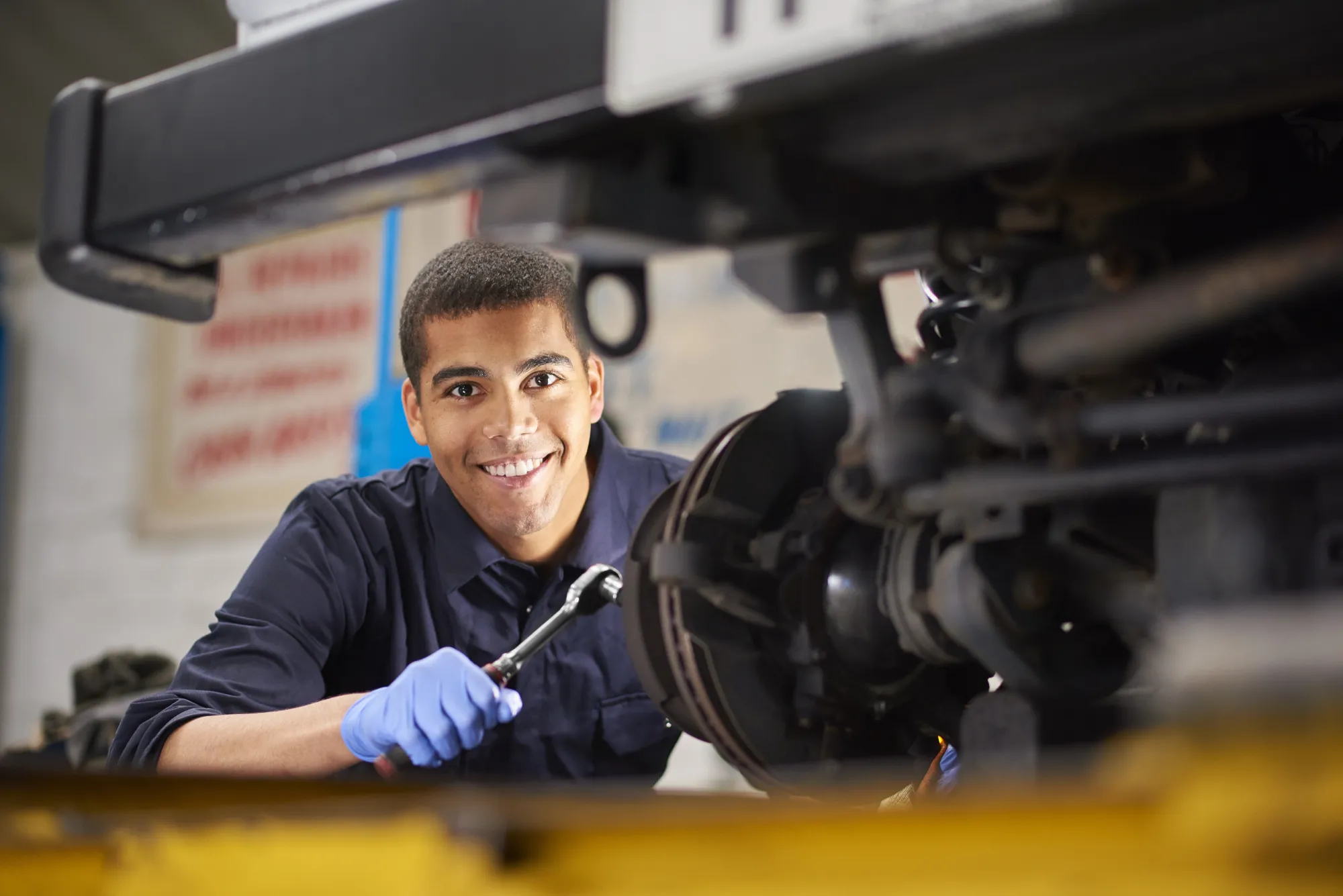
The difference from a disc job starts before any measuring happens. A disc brake can often be assessed with the wheel off and nothing else disturbed. A drum brake has to come apart first, and on a truck that’s lived through some eastern Oklahoma winters, getting a rusted drum off the hub can be the hardest part of the job.
Since the wheels are already off, it’s also the natural moment to look at what they’re wearing. If you’re due, our guide to when to replace your tires covers the signs worth catching on the same visit.
Once the drum is off, this is what gets checked:
- Lining thickness. Federal vehicle-in-use inspection standards say lining thickness shall not be less than one thirty-second of an inch over the rivet heads. That’s a floor, not a target. The practical replacement point is closer to a sixteenth of an inch above the rivets, or whatever the manufacturer specifies.
- The drum’s diameter. Every drum has a limit, and on drums made since the early 1970s the maximum safe diameter is typically cast right into the part. A drum can be machined true only if it stays inside that number. The discard spec commonly works out to about 0.060 inch over nominal on cars and light trucks. Past it, the drum gets replaced, not turned.
- Out-of-round. With the shoes adjusted to lightly drag, a technician rotates the drum by hand. If it binds and releases as it comes around, it isn’t round anymore.
- The wheel cylinder. The rubber end cap gets pried back to look for fluid seeping past the piston seal. Moisture in old brake fluid corrodes cylinder bores, pistons start to stick, and the brake pulls intermittently. Aluminum wheel cylinders get replaced rather than honed.
- The hardware. Springs, clips, the adjuster and its threads all get inspected and lubricated, or replaced.
Four of those five checks are impossible with the drum installed.
Why Nobody Can Quote Your Rear Brakes Over the Phone
Front pads and rotors are fairly predictable. Rear drums are not, because of how many separate yes-or-no questions live behind that drum.
Can the drum be machined, or is it past its maximum diameter? Is the wheel cylinder dry, or weeping under the boot? Is the adjuster free and reusable, or seized solid with rust? Are the springs still tight? Did a leaking cylinder soak the lining, which means new shoes regardless of how much material is left?
Every one of those answers changes the parts list, and not one of them can be answered over the phone or through a wheel. Any number you’re given sight-unseen is a guess dressed up as an estimate.
Guessing at a sealed-up system is how the expensive version of a repair starts. We’ve made the same point about what we find after a parts-store AC recharge can, and rear drums are the same situation with heavier consequences.
The honest way to do it is to get the truck on a lift, get the drums off, measure, and then tell you exactly what your vehicle needs. Bring it in and ask for a current quote on the actual findings rather than budgeting from what a neighbor paid for a different truck.
Where to Get Rear Brake Service in Sequoyah County
There’s one more reason this gets away from people. Oklahoma abolished its yearly mandatory vehicle safety inspection back in 2001, under House Bill 1081 signed that May. Nothing on the calendar makes anybody look at your rear brakes anymore. Your own attention is the entire inspection program now.
Rear drums are patient. They’re sealed up out of sight, they’re doing the lighter share of the work, and they’ll go a long way without complaining. Then the parking brake stops holding, or a noise shows up in reverse, and it turns out the shoes ran down to the rivets months ago.
So if you’ve been looking for rear brake service near you and wondering whether “rear brakes” even means the same thing on your truck as it does on the family car, now you know it doesn’t.
At Lee’s Tire Service, we’ve been doing brake repair in Sallisaw, OK since 1974, for drivers coming in from Roland, Muldrow, Vian, Gore and all over Sequoyah County. We’ve had plenty of drums off plenty of work trucks. We’ll pull them, measure what’s there, tell you which parts are still good, and put it back together right.
If something in the back of your truck has been nagging at you, don’t guess at it. Request a current quote and we’ll take a look at what your vehicle actually needs.