There’s a can sitting on a shelf at every parts store between here and Fort Smith. Trigger on top, short hose, a little round gauge, and a picture of a happy driver on the label. If your air has gone lukewarm in the middle of an Oklahoma August, that can looks like the most reasonable thing in the world.
We get the appeal. We’re not going to tell you that you did something dumb by buying one. Plenty of capable people in Sequoyah County have hooked one up in the driveway, and the EPA specifically allows it: small cans holding two pounds or less, with unique fittings and self-sealing valves, can be sold to anyone without a technician certification for use on their own vehicle. It’s legal, it’s on the shelf, and it takes about ten minutes.
What we want to do here is show you what we see at the shop when one of those vehicles rolls in afterward. Not to scold anybody. Just so you know what the can can and cannot do, and what a real diagnosis looks like when the cold doesn’t come back.
Why the Can Looks Like the Obvious Answer in a Sallisaw Summer
Heat is not a rumor around here. National Weather Service climate normals for Sallisaw put the average high at 85.8 degrees in June, 91.2 in July, and 91.6 in August. The record on the books is 111. September still averages 83.9, which is why we’re still taking calls about an AC not blowing cold in Sallisaw well past Labor Day. A vehicle with weak air in that kind of stretch isn’t a comfort problem. It’s a get-the-kids-home problem.
So the thinking goes: the air is warm, warm air means low refrigerant, low refrigerant means add refrigerant. The first two steps are often right. It’s the third one where things go sideways.
One Hose, Half the Story
Your air conditioning system has two sides. The low side is where refrigerant comes back to the compressor as a cool vapor. The high side is where the compressor sends it out under pressure, hot, to the condenser up front to shed its heat.
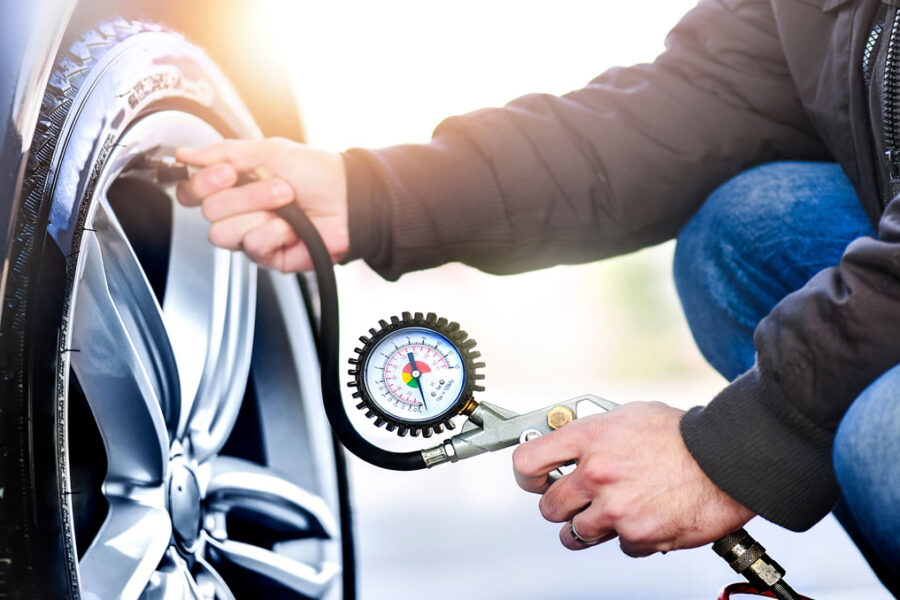
A parts-store can hooks to one of those. Just the low side. The fitting is built that way on purpose, so you can’t accidentally connect it to the high side, which would be genuinely dangerous.
Good safety decision. Terrible diagnostic one. Reading only the low side is like checking one tire and calling the whole set good. The high side is where an overcharge shows up first, and the can has no way to see it.
Then there’s the gauge. That green band on the dial isn’t a fixed target. A healthy low-side reading moves with outside temperature, humidity, engine speed, and how long the system has been running. A needle sitting pretty in the green on a 70-degree spring morning means something completely different on a 95-degree afternoon in Vian. The can can’t ask what the temperature is.
Your System Is Charged by Weight, Not by Feel
Here’s the part most people have never been told. Your vehicle’s air conditioning system isn’t filled to a pressure. It’s filled to a weight.
Open the hood and find the sticker, usually on the radiator support or under the hood. It names the refrigerant type and a specific charge amount in ounces or grams. That number came from the engineers who designed the system, and modern systems hold a surprisingly small amount. Tolerance is tight.
Think about what the can is being asked to do. To hit that number, you’d have to know exactly how much is in there right now, then add exactly the difference. The can can’t weigh what’s already in the system. Neither can you. Every driveway top-off is an educated guess, and the only feedback is a needle on a band that shifts with the weather.
Sometimes the guess lands close and the air gets cold. Sometimes it lands long.
Why Too Much Refrigerant Cools Worse Than Too Little
This is the one that surprises people, and it’s why we see vehicles come in worse after a recharge than they were before.
When there’s too much refrigerant in the system, pressure on the high side climbs. The condenser in front of your radiator has a fixed amount of surface area to dump heat through, and when it’s packed too full, less of that surface does useful work. The compressor is now pushing against higher pressure to move the same heat. Cooling capacity goes down, not up.
The pattern is distinctive, and once you’ve seen it you’ll recognize it:
- The air got worse right after the recharge, not better
- It cools acceptably at highway speed on I-40 and goes warm sitting at a light in town
- The compressor clicks on and off more often than it used to
- The cooling fans seem to run harder and longer than they used to
The idle part is the tell. Rolling toward Roland or Fort Smith at highway speed, air is forced through the condenser and it can shed heat despite the high pressure. Stopped at a light in Sallisaw, the only airflow is what the fans can pull, and the system loses the fight.
There’s a related problem the can introduces on the way in. If the hose isn’t purged of air first, you push atmosphere into a system meant to hold nothing but refrigerant and oil. MACS, the mobile air conditioning trade association, has documented what that does: as air contamination climbs from zero to 7.7 percent to 18.9 percent, system pressures and temperatures degrade badly. In one case they wrote up, roughly 20 percent air contamination drove the high side over 400 psi, and the high-pressure cutout started cycling the compressor off and on. Air doesn’t condense. It just takes up room and raises pressure.
The Sealant Problem Nobody Mentions on the Label
A lot of the cans on that shelf aren’t plain refrigerant. They also carry a stop-leak sealant, often with an oil charge and a conditioner. The label treats that as a bonus feature.
Sealant works by reacting with the moisture and air it meets at a leak and hardening there. Trouble is, it can’t tell the difference between a leak and any other place in the system where it happens to meet moisture. It can harden in the condenser, in the evaporator, or inside the compressor. Those are not small repairs.
The bigger issue is what it does to your options afterward. When a shop performs auto AC service in Sallisaw or anywhere else, the first step is pulling the existing refrigerant out through a recovery machine. If sealant is in the system, it goes through that machine, and it can contaminate and ruin it. That’s why many shops decline to work on a system that has had sealant in it. It isn’t stubbornness. One contaminated vehicle can take a shop’s recovery equipment out of service for every other customer in the bay line.
If you’ve already used a sealant can, tell us when you call. That’s not a confession, it’s useful information, and it changes how we approach the job.
A Can Hides the Leak Instead of Finding It
Refrigerant isn’t a consumable. It doesn’t burn off or get used up like oil or wiper fluid. Your air conditioning system is sealed. If it’s low, that isn’t maintenance catching up with you. It means refrigerant left, and there’s a hole where it went out.
That changes what a top-off actually is. You aren’t fixing anything. You’re replacing what escaped through an opening that’s still open, and it will leave the same way the last batch did. The only question is how long it takes.
We see it every summer. A driver in Muldrow adds a can in early July, gets a genuinely cold week or three, and is back to warm vents by August, convinced the system needs something major. Often it didn’t. It needed a leak found while it was still small.
There’s one more consequence to the delay. A system low on refrigerant is also low on the oil that circulates with it, and that oil is what keeps the compressor alive. Running it low for a whole season is how a leaking O-ring turns into a compressor job. Same logic as a battery you keep jump-starting instead of testing: the engine fires, but nothing has been diagnosed.
What Real Car AC Repair in Sequoyah County Actually Looks Like
When you bring a vehicle to us for AC service and recharge with the air not blowing cold, here’s the actual sequence. None of it is mysterious, and all of it exists because guessing doesn’t work.
We identify what’s in the system first. Refrigerant type, and whether anything is in there that shouldn’t be. This is also where sealant turns up.
We recover the refrigerant. Federal rules require shops to use certified equipment and certified technicians, and the refrigerant that comes out has to be recycled or reclaimed before it goes back in. Shops keep those records on site for three years. That’s the biggest reason a shop’s process looks nothing like a can: we can’t just vent it and start over, and we wouldn’t want to.
We pull the system into a deep vacuum and watch it. A vacuum does two jobs at once. It boils moisture out, and it tests whether the system holds. If the gauge creeps back up while it sits, there’s a leak, and no amount of refrigerant will change that.
We find where it’s leaking. Two tools do most of this work. An electronic detector, run along the lines and fittings, sniffs out escaping refrigerant. The performance standard for those detectors on R-134a systems requires at least three selectable sensitivity scales, down to 4 grams a year, which is a leak far too small to hear or feel. The other is fluorescent dye. We add it, run the system at least 15 minutes so it circulates, then look under UV light. Slow leaks sometimes need a second visit so the dye has time to collect and glow.
We repair what we found. An O-ring, a Schrader valve, a hose, a condenser. It gets fixed, not covered up.
We recharge to the sticker weight. Machine-measured, to the number the manufacturer specified, not to a needle in a green band.
We verify. Vent temperature, pressures on both sides, compressor behavior at idle and off idle, hood up, system doing its job.
That whole sequence is what a proper AC recharge in Sallisaw, OK includes. The refrigerant going back in is the last step, not the first one.
A Quick Word on Which Refrigerant Your Vehicle Takes
Older vehicles around Sequoyah County mostly run R-134a. Newer ones use R-1234yf, which the EPA lists as acceptable for new passenger cars and light trucks and which is now in most light-duty vehicles. It has a global warming potential of 4, against 1,430 for R-134a, which is why the switch happened.
The two aren’t interchangeable, and the service fittings are deliberately different sizes so the wrong equipment won’t attach. If you’ve taken a can out to a newer truck and the hose won’t connect, nothing is broken. That’s the design working. Check the underhood sticker before buying anything.
When to Stop and Bring It In
Skip the can and get it looked at if any of these fit:
- You’ve already added refrigerant this year, or last year, and it went warm again
- The air got worse after a recharge instead of better
- It blows cold rolling down the highway and warm at a stop light
- You hear the compressor clicking on and off rapidly
- There’s an oily, greasy film on any AC line, fitting, or on the condenser
- The air smells musty, or the airflow is weak even when the air is cold
- The compressor never engages at all when you turn the AC on
- You’ve used a sealant product at any point
Any one of those means the system is telling you something a top-off won’t answer.
Get a Current Quote for Auto AC Service in Sallisaw
We’re not going to print a number in a blog post. Parts and labor move around, and what your vehicle needs depends on what we find when we look. A number typed here months ago would be worse than none at all, because you’d plan around it.
What we will do is look at your vehicle and tell you what it needs before any work starts. Straightforward recharge or leak repair, you’ll know what you’re agreeing to before we begin.
We’re the shop folks around here call after the can didn’t hold, and we’d rather see the vehicle first. If your AC is not blowing cold in Sallisaw, Muldrow, Roland, Vian, Gore, Stilwell, or anywhere else along the I-40 corridor, request a current quote from Lee’s Tire Service and we’ll get you back to cold air.