The damage has already happened. Maybe you heard the thump on Highway 59 coming in from Roland and now there is a knuckle-sized bulge on the sidewall. Maybe there is a screw standing straight up in the tread. Maybe the set you bought two winters ago is showing bald bands well short of the miles promised.
Whichever it is, the next question is the same: is this covered?
That depends on which of two separate coverages your tires are riding on, and on what you can put on the counter when you walk in. A tire road hazard warranty Sallisaw OK drivers buy is a different animal from the manufacturer’s tread-life warranty. Different damage, different paperwork, different answer. Here is how it actually works.
Your tires probably carry two warranties, not one
Two different pieces of paper are usually in play.
The first is the tire manufacturer’s limited warranty: the tire maker’s own promise, covering defects in workmanship and materials plus a tread-life or mileage promise that the tread will last a stated number of miles under normal use.
The second is a road hazard protection plan, optional and sold by the retailer rather than the tire maker, covering what the road does to a perfectly good tire.
Here is the part that surprises people. The manufacturer’s limited warranty explicitly does not cover road hazard damage. Goodyear’s published limited warranty puts damage from snags and impact breaks right on its not-covered list, alongside damage from improper inflation, overloading, misuse, negligence, improper mounting, improper repair, wreck, collision, and fire.
That is not the tire maker being difficult. A nail is not a manufacturing defect. The tire left the factory fine and the road ruined it. That gap is exactly the hole a road hazard plan fills.
So when a customer says “the tires are still under warranty,” the useful follow-up is: under which one?
What a tire road hazard warranty Sallisaw OK drivers buy actually covers
Plans vary by retailer, but the language is remarkably consistent. A typical policy covers a tire that becomes unserviceable from road hazards, defined as cuts, snags, bruises, impact breaks, or other un-repairable punctures.
Two words in that definition do most of the work.
Unserviceable. The tire has to be finished, not merely wounded. Published policies usually exclude tires that can safely be fixed, so a repairable puncture gets repaired rather than replaced. Most plans include the flat repair, so that is not the bad news it sounds like.
Road hazard. The damage has to come from the road, not from the vehicle or from neglect. The same policies exclude tires damaged by run-flats, wheel misalignment, cosmetic damage, and tires run over- or under-inflated, plus cases where necessary vehicle maintenance was not performed. Vandalism and collision are out too, because those belong to your insurance. Road service and towing are typically excluded, and mounting, balancing, and taxes normally stay with the customer.
The pattern is simple enough. A road hazard plan answers for what the road did to a good tire, not for what the car did to its own tires.
What a tread-life warranty actually answers for
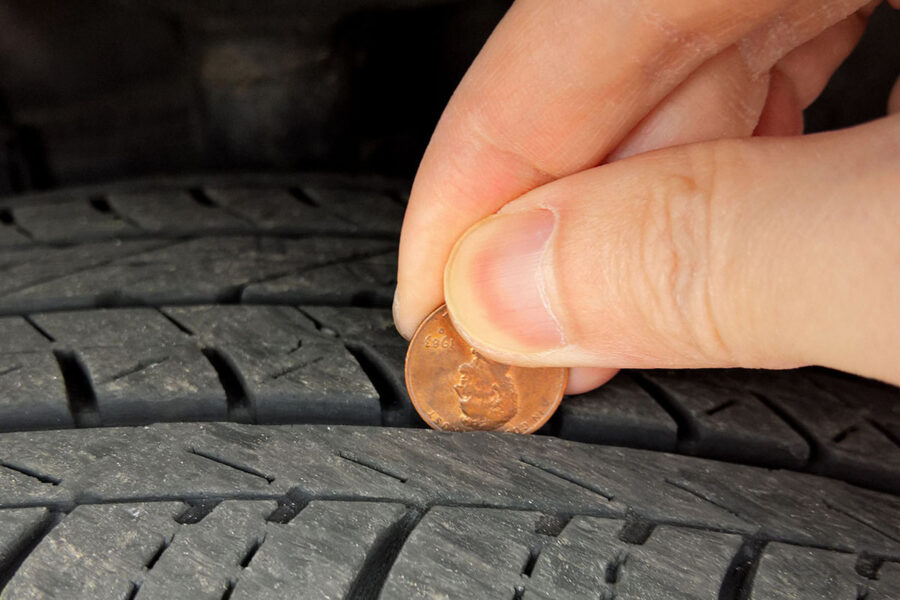
The tread-life or mileage warranty covers something narrower than people expect: tread that wears evenly down to its treadwear indicators before the warranted mileage is delivered.
Evenly is the first hurdle. Irregular wear (feathered edges, one shoulder gone, cupping, a band worn through the middle) is not tread life falling short. It is a symptom. Goodyear’s own guidance warns that lack of rotation, worn suspension parts, underinflation or overinflation, wheel imbalance, and misalignment can all cause vibration or irregular tire wear. A tire worn out on one edge reads as a vehicle problem, not a tire problem.
Rotation is the second hurdle, and it is a requirement rather than a friendly suggestion. Manufacturers ask you to rotate according to the vehicle maker’s recommendations, or at maximum intervals of 6,000 miles. If you cannot show it happened, you are arguing about tread life with nothing behind you.
The third hurdle is a hard stop. A tire has delivered its full original tread life, and coverage ends, when the treadwear indicators become visible. Once the tread is gone, so is the warranty. Our post on when to replace your tires covers spotting those indicators before you get there.
There is a clock, too. A prorated adjustment typically runs up to six years from the date of original purchase, so an old set can age out of coverage even with tread left on it.
Why a nail in the tread and a nail in the sidewall are two different conversations
Same nail, same drive home, completely different outcome. The reason is not policy. It is physics, written into repair standards.
The U.S. Tire Manufacturers Association is direct about it. Repairs are limited to the tread area. Damage must not extend into the shoulder or belt edge area, no repair is permitted where the injury runs at an angle into the shoulder, a repairable puncture cannot be greater than a quarter inch (6mm) in diameter, and repairs cannot overlap another repair.
The standards also spell out how a legitimate repair is done. The tire must be removed from the rim and wheel assembly and inspected for all possible damage, including damage to the inner liner. Then a rubber stem, or plug, fills the puncture and a patch seals the innerliner. Both parts. A plug alone is an unacceptable repair.
That is why a tire repair Sallisaw OK shops will stand behind takes longer than plugging a hole in the parking lot. The tire comes off the wheel and gets looked at from the inside, because a nail that looks harmless from outside may have chewed the innerliner or the belts on the way through.
Three nails, three answers:
- Nail in the middle of the tread, small hole. Inside the repairable zone and under the size limit. It comes off the wheel, gets inspected, gets a plug and a patch, goes back on. Because it can be safely fixed, a road hazard plan generally directs the repair rather than a new tire.
- Nail in the shoulder or sidewall. Same nail, wrong neighborhood. Outside the repairable area, so the tire is unserviceable no matter how much tread is left. That is the road hazard plan’s job, never the manufacturer’s.
- Nail beside an existing repair. Repairs cannot overlap, so the location of the old patch can end the conversation on its own.
The pothole bubble is its own category
A bulge on the sidewall is not a slow leak and it is not cosmetic. It is an impact break. The tire hit something hard enough to break a belt or body ply inside the casing, and the air is pushing out through the weak spot. Nothing hisses. Nothing feels wrong from the driver’s seat. The tire is still done.
Impact breaks are not repairable and are not manufacturing defects, which puts them squarely in road hazard territory.
They are also seasonal here. Oklahoma’s Department of Transportation has said plainly that the repeated freeze-thaw cycle during winter contributes to more potholes and work zones in the months that follow. One recent winter response ran through 44,000 tons of salt and sand and more than 507,000 gallons of brine. Water gets into pavement, freezes, expands, thaws, and repeats until the surface fails. Then the road starts taking tires. I-40, Cherokee Avenue, a county road out toward Vian: the pavement does not care.
For drivers in Sallisaw and across Sequoyah County, that makes the road hazard side of your paperwork worth understanding in late winter and early spring, not in July. And if a hard hit knocked a wheel out of alignment, that is a second problem, because the misalignment wear that follows is excluded from both coverages. If a bulge appears, drive on it as little as you can and get it looked at.
Why prorated coverage means nobody can quote you over the phone
Both kinds of coverage are prorated, and proration is measured, not guessed.
On the road hazard side, coverage applies during the usable tread life of the tire, and usable tread is the original tread depth minus 2/32 of an inch. You receive a credit for the usable tread remaining, based on your original purchase, and that credit comes off the replacement tire. Retailers work from a table keyed to measured 32nds, so the credit shrinks as the tread does, and a tire worn all the way to 2/32 has no usable tread left to credit at all.
On the manufacturer’s side, a prorated adjustment works from the tire’s advertised selling price at the time of adjustment and the percentage of usable original tread that has worn off, with mounting, balancing, and applicable taxes staying with the customer.
Both calculations need the same input: a tread depth reading taken off your tire with a gauge. That is why an honest shop will not give you a figure over the phone. Anyone quoting a number sight unseen is guessing at the one variable that decides the answer.
So bring the tire in. Once it is measured we can tell you exactly where you stand. If you want it in writing before you commit, request a quote and we will work from real numbers off your vehicle.
One more wrinkle. A prorated replacement puts one full-depth tire next to three partly worn ones, so we measure all four and talk through where the new tire goes. Deepest tread belongs on the rear.
What to bring for a tire warranty claim Sequoyah County shops can process
A tire warranty claim Sequoyah County drivers bring us moves fast when the file is complete and stalls when it is not. Four things do most of the work.
- The original purchase invoice. It has to show the tire description, the date, and the vehicle mileage at installation. A missing invoice is the single most common reason a claim slows down.
- Documented rotations. Anything showing the tires were rotated on schedule: our records, another shop’s invoices, or a folder in the glovebox.
- The damaged tire itself. Not a photo. It gets inspected, and on a manufacturer adjustment it becomes the property of the tire maker, so it has to physically change hands.
- Usable tread still on the tire. Coverage ends at the treadwear indicators. Once the tread is gone, so is the claim.
You will also sign a claim form. Manufacturers require it on their own approved form, supplied by an authorized service facility, filled out completely and signed.
What if the invoice is long gone? You are not out of luck, but the terms get less generous: without proof of purchase, the date of manufacture stamped on the sidewall determines eligibility instead. That DOT date code is when the tire was built, not when you bought it, and tires often sit before they sell, so it almost always shortens your window.
One more note: retreaded passenger and light truck tires are not warranted by the tire manufacturer for any reason.
Keep the paperwork from day one
None of this is complicated, but it is hard to reconstruct after the fact. From the day a new set goes on:
- Photograph the invoice and email it to yourself, so it lives somewhere other than the glovebox.
- Get the rotations done on schedule and keep them in one place. Our guide on making your tires last longer covers the routine that also protects your tread-life coverage.
- Ask whether a road hazard plan was included, and get the answer on the invoice.
- Keep an eye on pressure. Tire makers recommend inspecting tires, spares included, at least monthly for inflation, damage, and treadwear, and both coverages exclude damage from running over- or under-inflated. If your TPMS light comes on, find out why before you reset it.
No warranty is a promise that a tire cannot fail. Tire makers say as much. Service life cannot be predicted in calendar time, because how long a tire stays serviceable depends on inflation pressure, load, speed, road hazard injury, and the rest of what it lives through.
Bring it to Lee’s and let us sort it out
You do not have to figure out which warranty applies before you come in. That is our job. Bring the tire and the invoice if you have it. We will measure the tread, inspect the damage, tell you which coverage is in play, and handle the paperwork.
If a claim does not cover as much as you hoped, we will tell you straight, give you a current quote on your options, and point you to financing if that helps.
Lee’s Tire Service is on East Cherokee Avenue in Sallisaw, and warranty questions are a normal Tuesday here. If you have a nail, a bulge, or a set that wore out early, schedule an appointment and let us take a look.